
Are Smarter People More Liberal?

Sculpture of man emerging from ape

Emergent Man

Ah, yes, another article proclaiming that smart people are liberal. Elizabeth Landau of CNN reports on a soon-to-be-published article by evolutionary psychologist Satoshi Kanazawa that claims higher IQ is associated liberal politics and religion, as well as “sexual exclusivity” (a.k.a. monogamy).

I haven’t seen the article (it’s not available yet), but there are a couple of problems with the simple equation “smart = liberal.” First, notice how “liberal” is defined:

The study takes the American view of liberal vs. conservative. It defines “liberal” in terms of concern for genetically nonrelated people and support for private resources that help those people. It does not look at other factors that play into American political beliefs, such as abortion, gun control and gay rights.

Strange definition. In America, conservatives favor the use of private resources to help people. As far as the “genetically nonrelated” issue, I have no idea what that’s supposed to mean. Part of the problem here – as with most discussions of liberalism and conservatism – is that the terms can mean many different things. Continue reading
On Citing Wikipedia

Let’s be clear: You should never, ever cite Wikipedia in an article or book, unless you writing about Wikipedia itself. But it drives me crazy when people hear the word “Wikipedia” and immediately respond, “Wikipedia? Give me a break. It’s so unreliable.”

There is nothing wrong with using Wikipedia to get a quick sense of a subject and to lead you to more reliable sources. Encyclopedias, survey-level textbooks, desk references, and similar resources have been used the same way for generations. If you are trying to nail down some definitive piece of information, then you should never settle for Wikipedia. As your starting point, however, I think there are few options that are much better.

For that matter, Wikipedia is an excellent resources for certain subjects, such as:

  • Controversial subjects that many people, with many different perspectives, care a great deal about. Theology is a great example. If Catholics, Calvinists, Wesleyans, Orthodox, and even Swedenborgians can come up with an article on justification that they all more or less accept, I bet that’s going to be a pretty decent article.
  • Obscure pop culture facts, like alternate versions of the comic book character Nightcrawler.
  • People you are encountering for the first time, and need to get a quick triangulation on them, like Emanuel Swedenborg.

I use Wikipedia everyday, and there’s nothing wrong with it. If Wikipedia is your only source of information, then there’s something wrong with you, but don’t blame Wikipedia.

Emerging Scholars at Jubilee 2010

Cross-posted from the Emerging Scholars Blog

Byron Borger

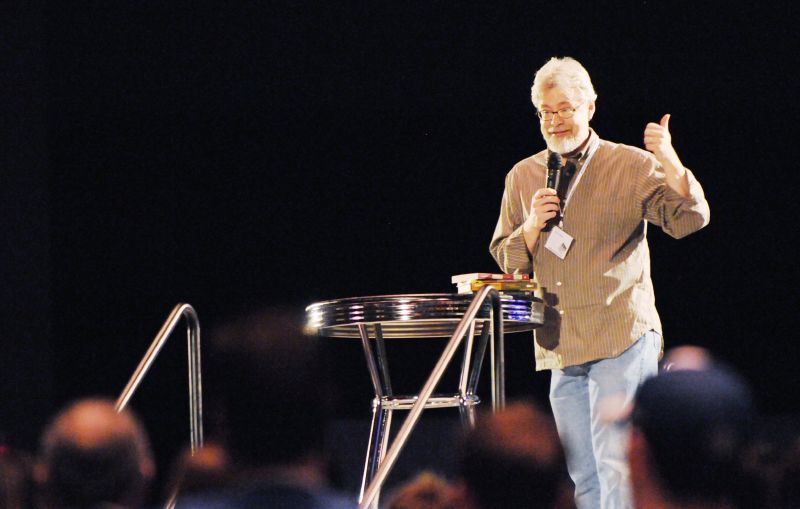
Byron Borger at Jubilee 2009

I spent the weekend at Jubilee, the annual student conference of the Coalition for Christian Outreach. Jubilee has a great reputation for emphasizing the theology of vocation – a reputation which was confirmed, by the way – but I didn’t expect the high level of fun generated by the conference. Saturday evening featured a hilarious (and moving) monologue from actress and writing Susan Isaacs (author of Angry Conversations with God) and a can’t-possibly-be-true-except-he-brought-pictures talk from Bob Goff, president of Restore International and good friend of Don Miller.

Photo: Byron Borger at last year’s Jubilee, but he looked basically the same this year. From livingjubilee via Flickr. Click for a larger image.

Occasionally, these streams of fun and vocation combined, such as the first night. In quick succession, seven speakers presented pecha kucha, a speed-presentation format of 20 slides, changing automatically every 20 seconds, whether the speaker is ready or not. The pecha kucha presenters included:

  • David Greusel, an architect speaking on the connection between architecture and faith, especially what he called “the lie” that “secular work” doesn’t matter in God’s kingdom on earth (Greusel was the lead designer of Pittsburgh’s PNC Park).
  • Gideon Strauss, President of the Center for Public Justice, who testified to the application of Isaiah 58 in our current society.
  • Leroy Barber, president of Mission Year, speaking about Green My Hood, a program which identifies the abuse of the environment in poor urban neighborhoods and looks for ways to bring good creation stewardship into the inner city.
  • Good friend of ESN Byron Borger of Hearts & Minds Books, who said that “part of this conference is learning to read deeply,” and reminded us that the word “disciple” means “student.”

As Benson Hines (who was also there) said on Twitter,

Lord, let me be as passionate about my calling as Byron Borger is about his.

More about Jubilee and some upcoming articles after the jump Continue reading

New World Religions Class Starting

Wat Arun, BangkokI’ll be starting one of my favorite teaching series next month: World Religions.  Here are the details.

Where: Lakeside Christian Church, Lakeside Park, KY (directions)
Dates: March 3 through May 5 (no class March 24 or April 28)
Time: 6:30pm to 8pm

We’ll be covering the history, beliefs, and practices of major world religions and new religious movements, including:

  • Christianity
  • Judaism
  • Islam
  • Hinduism
  • Buddhism
  • Mormonism
  • Wicca
  • Scientology

…with a few more thrown in just to be safe. The class will include time for discussion and coverage of the current state of each religion in the world and the U.S.

I hope you can make it!

Photo: Buddhist Temple in Bangkok, Thailand, by Stuck in Customs via Flickr

ESN Makes the News!

The good work of my InterVarsity colleague (and fellow ESN blogger) Tom Grosh has been recognized by his local paper. Tom is hosting an Emerging Scholars Network event later this month, “The Sociology of Faith,” featuring Christian college professor Donald Kraybill of Elizabethtown College. Kraybill will draw upon his academic expertise as a scholar of Amish culture, as well as his personal experiences, in discussing the impact of Christian faith on one’s work and study.

“Each academic discipline raises different questions for (Christians who are involved in those disciplines),” he explained. “I’ll be talking about some of the issues I’ve struggled with as a Christian and as a sociologist (and about) the ways that I, as a Christian, can teach sociology.” He added that he will focus on ways that individuals can work through issues such as the ones he experienced.

Pray for Tom as he finishes organizing this event. Pray, too, for the students, faculty, and church members who will attend the event and for Donald Kraybill as he prepares his talk.

Also, read Tom’s latest post on the ESN blog, What are you picking up for Lent? We’re used to the idea of giving up something to grow closer to God, whether for Lent or some other reason, but what about adding something to our lives?